2023 Dec
Refiled
2026 Sep
How couples meet in the US
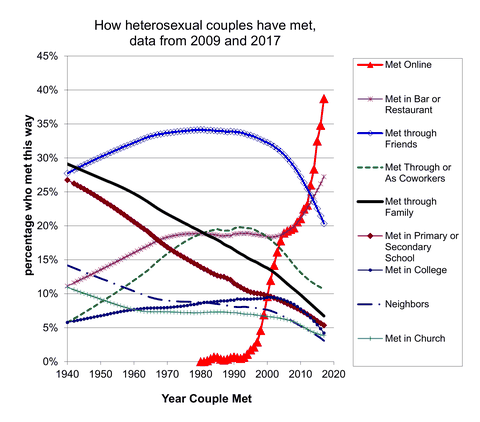
Every year or so a chart goes viral, showing how American couples have met over time. Before 2023, it wasn’t the one above. The original chart depicts the rise and fall of “meeting through work”, the rise of online dating, and the collapse of just about everything else.
But not everything else. Alongside meeting “online”, the original chart shows “meeting through bars & restaurants” rising sharply since 2010. It’s the only category rising alongside online dating. Does it mean people are meeting, dating, and marrying strangers at bars more and more? This would make sense, after all, as it might be a natural consequence of the much-discussed demise of communities and third spaces.
This question tugged at me: would the answer even be knowable? One day I dug up the original paper to find out.
The chart comes from How Couples Meet and Stay Together, a long-running survey devised at Stanford by Michael Rosenfeld, Reuben Thomas and Sonia Hausen. It’s landmark work. But on page five the authors noted something the original chart never mentioned:
Figure 1’s apparent post-2010 rise in meeting through bars and restaurants for heterosexual couples is due entirely to couples who met online and subsequently had a first in-person meeting at a bar or restaurant or other establishment where people gather and socialize.
Allowing people to count for multiple categories makes sense in many cases—“marrying the brother of a coworker” should count for both family and work, for example. But if you have your first date at a coffee shop… does that mean you “met” there just as much as you met online? Absolutely not.
That left the question: how much of a decline had there really been? Up until 2023, all variants of the chart published—from scientific papers to the Economist—followed the double-counting method. How much would change if people who met online, first, were removed from the other categories?
In 2023, our relationship science team dove into the original survey data to redraw the chart. It includes 6,519 couples across a handful of different surveys. Marriage Pact statistician Eden Gibson re-constructed the chart from the original data, making sure people who met online weren’t double-counted. Professor Rosenfeld, author of the original study, kindly advised us on smoothing.
We posted the updated chart to reddit as /u/WorldlyWeb in December 2023, and it shot to the front page, earning 7 million views in a day. It has since ricocheted across the internet, just like its predecessor did. But now, it tells the story that’s really happening: meeting online is crowding out every other way of meeting, and it isn’t even close.
It’s been surreal, but mostly wrenching, to hear directly from people around the world about how this chart makes them feel. Someone on reddit put it this way: “I met my partner in 2011, before dating apps took off. It feels like I got the last chopper out of ’Nam”.
As algorithms become responsible for more and more of our relationships, it’s possible they will rewire society—intentionally or not. It’s critical, to me, that they create more meaningful relationships, and that they accomplish something that serves humans—not just more on-app engagement.
It’s rare to find such a widely-used piece of social infrastructure that’s so widely disliked. I hope we might create something better.
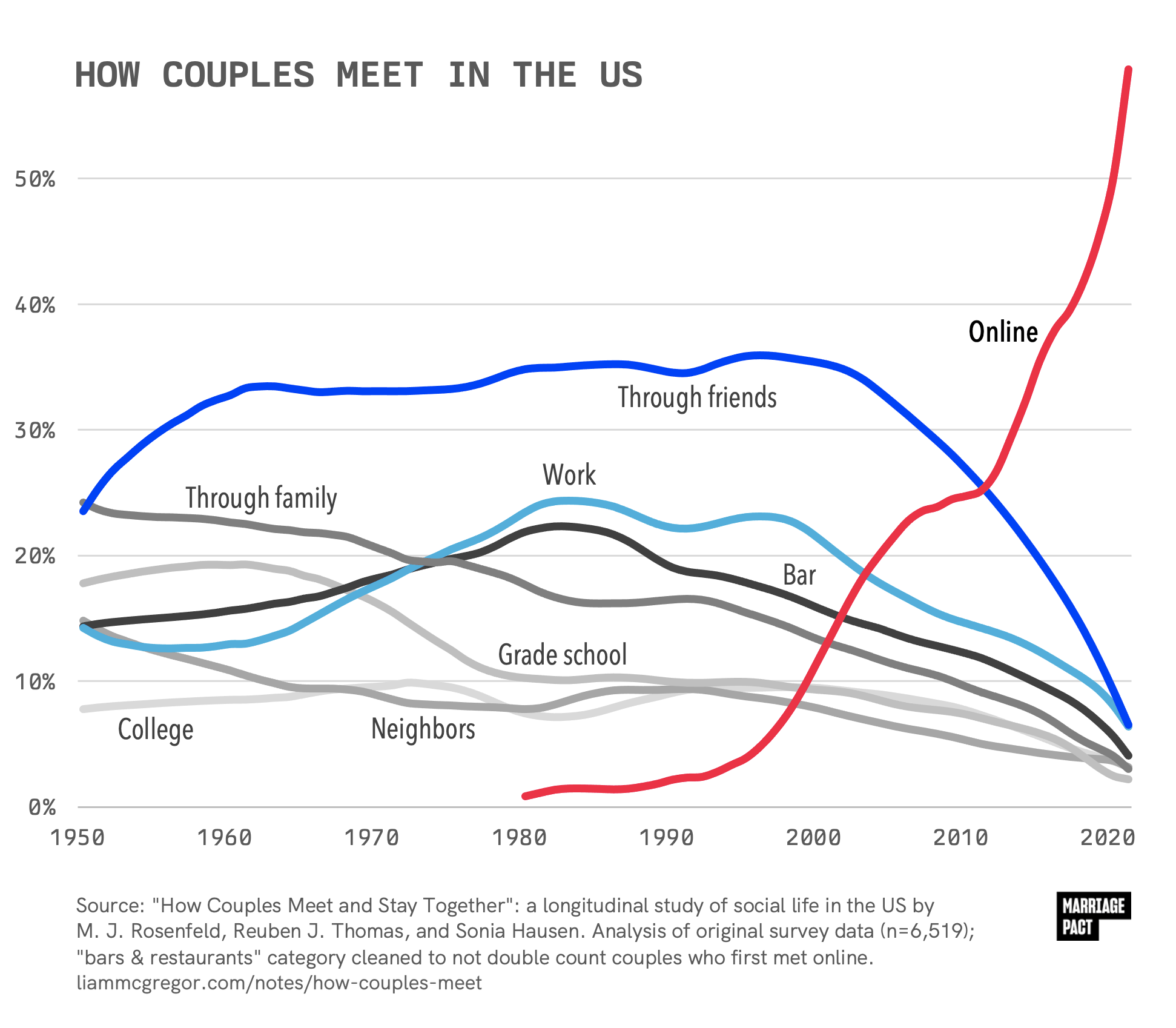 How couples meet in the USPNG, 1942 × 1697, 89 KB.Download the chart
Free to share unaltered, with credit; not for commercial use. CC BY-NC-ND 4.0
How couples meet in the US: today, 59% of heterosexual couples meet online, while 41% meet in person, including just 7% through friends, 6% through work, and 4% out at bars or restaurants. Between 1991 and 2021, meeting online soared from 2% to 59% of couples, and every other way of meeting plummeted: in 1991, 35% met through friends, 22% through work, and 19% at bars or restaurants. The viral chart was created from a new analysis of Stanford’s original survey data.